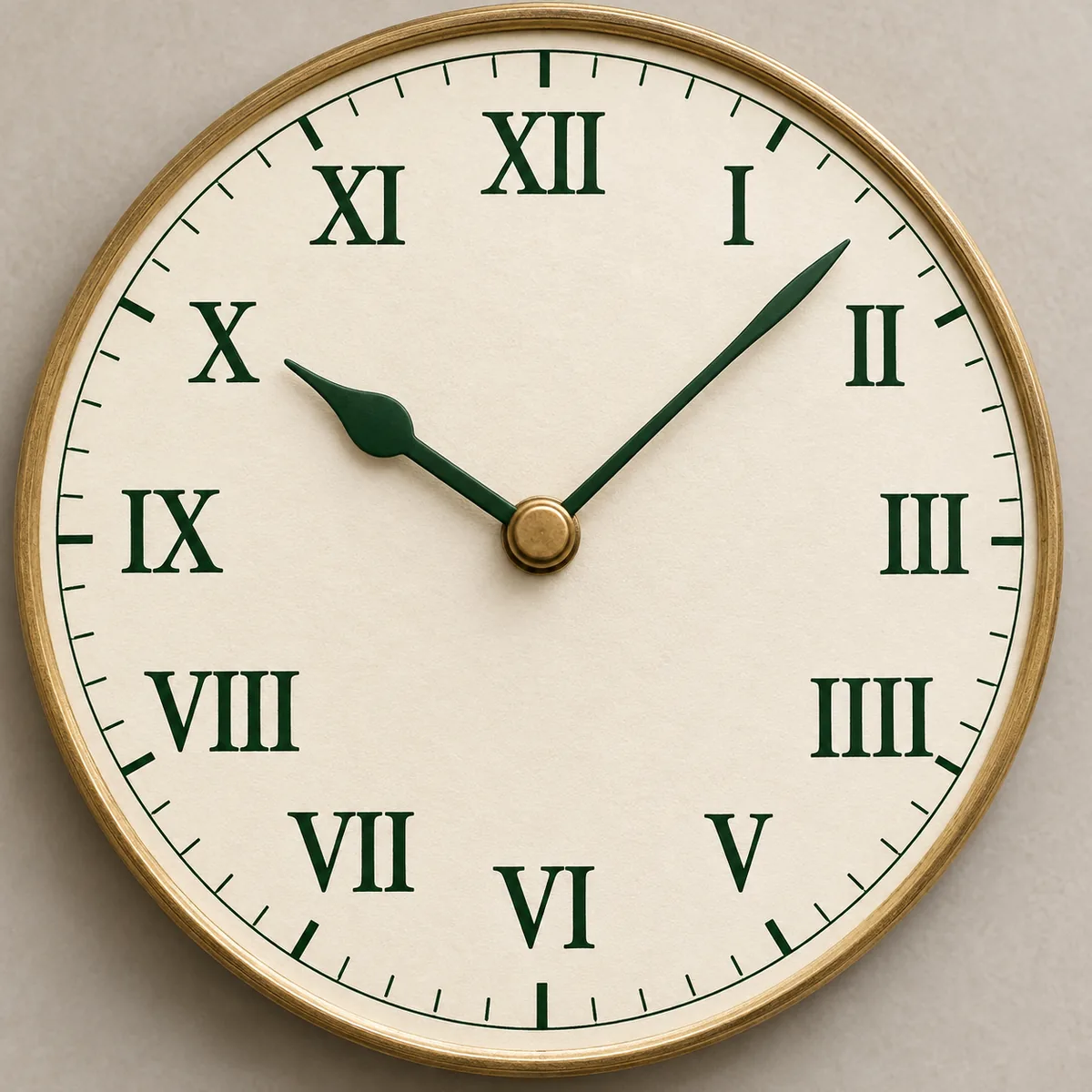
Most school rules write four as IV, yet some clock dials show IIII. It is a familiar dial convention, but its exact origin has no single confirmed explanation.
IV AND IIIICLOCKSHISTORY
THE SHORT ANSWER
The answer in brief
Why do clocks use IIII instead of IV? There is no single proven answer. IIII is a traditional design choice for some dials, while modern school exercises usually use IV for four. Visual balance, readability, and custom are often suggested, but none should be presented as a universally proven origin.
The question why do clocks use IIII instead of IV combines the history of notation with object design. Keeping those subjects separate helps distinguish a dial style from the standard rule used to convert numbers.
When you look at a clock with Roman numerals, you may expect IV at four o’clock. Some dials show IIII even though the rest of the sequence includes forms such as VI, IX, and XII. That is not automatically a manufacturing error: the dial follows a visual convention that has endured in watchmaking.
IIII adds four units; IV subtracts one from five. Both can be understood, but a clock face and a school conversion exercise follow different conventions.
Some clock dials use IIII even though IV is the standard form usually taught for writing four in an exercise.TWO FORMS, TWO CONTEXTS
IV and IIII both represent four, but they do not fit every task equally
Roman notation was written with conventions that changed across periods, places, and uses. In modern teaching, IV is the standard form for four. A dial may keep IIII as a design choice or through watchmaking tradition. The object tells you how to read it.
IV subtracts one from five; IIII adds four units. Seeing the latter on a dial does not change the form normally expected in a school conversion.
Form
Value
Common context
IV
4
The standard subtractive form commonly taught for writing four.
IIII
4
An additive variant that appears on some clock and watch dials.
VI
6
V followed by I is additive; it is not another way to write four.
In short: IV is usually the expected answer in an exercise. IIII can be intentional on a dial; copying that design choice does not make IIII the standard form for schoolwork.
CONTEXT
Roman writing was not identical on every historical object
The modern system is often explained with seven symbols and six subtractive pairs, but historical inscriptions did not always follow one uniform convention. Additive forms for four appear on older objects, while IV spread in other uses. That variety helps explain why a clock mark can preserve a form that is not preferred in class today.
Mechanical clocks and their dials have their own history. Numerals on a face also depend on legibility, materials, composition, and choices made by makers or buyers. A dial practice can therefore continue without one decree explaining every clock that uses IIII.
IVThe usual subtractive form for four in modern notation.
IIIIAn additive spelling found on some surviving dials.
WHAT IS KNOWN AND WHAT IS PROPOSED
Common explanations are theories, not one proven universal cause
Watchmaking sources often list several possible reasons. A clock museum also records more than one explanation and treats them as theories. A memorable story does not prove that it began the practice in every place and period.
The evidence supports describing IIII as a dial choice with historical additive precedents. It does not tie every dial to one royal order, religious belief, or symmetry calculation. Each explanation should be identified as a possibility when a direct record is missing.
Visual balanceIIII may look balanced against VIII on the opposite side of a dial. This is a plausible design explanation cited by watch sources, but it does not identify the historical origin of every dial.
Reading the dialSome accounts suggest that IIII is easier to distinguish from VI when a face is viewed from certain angles. This is relevant to legibility, but it does not prove that every maker chose it for that reason.
Inherited customA form used early can be repeated because makers, tools, and buyers already recognize it. Continuity can explain how a convention lasts without identifying who first started it.
Jupiter or French kingsStories claim that IV was avoided because it resembles the Latin name of Jupiter or because a French monarch ordered a change. They circulate in popular writing, but should not be treated as established facts without primary historical evidence.
Evidence limit: the sources reviewed do not establish one explanation. The cautious conclusion is that IIII is a dial convention with several proposed origins, not a universal rule that replaces IV.
READING THE DIAL
Why IIII can fit the design of a clock face
A dial is not a list of exercises. It places twelve marks around a circle, leaves room for the hands, and needs to be readable from a distance. Each numeral is also a graphic shape. A designer may prefer four vertical strokes at the four o’clock position because they fit the rest of the composition.
Symmetry is a visual explanation, not a mathematical rule requiring IIII. A dial may group I through IIII, then V through VIII, and finish with IX through XII to create a regular rhythm. Other dials use IV and can be just as clear.
Readability also depends on size, typeface, contrast, and viewing angle. For a replica, engraving, or illustration, look at the complete model and keep the chosen style consistent.
Four belongs to a complete circular composition, not an isolated conversion.
IIII and VIII can create visual balance across the dial.
Size and typeface affect legibility; makers can choose IV or IIII.
A PRACTICAL CHOICE
Which form to use in homework, a clock, or an engraving
Choose the spelling for the task, not only because you saw it on a dial. If you are converting a number, keeping an editorial style, or copying an object, these checks separate the cases:
1For class or conversion
Write IV for four unless the instruction asks you to reproduce a dial or another object exactly.
2When describing a clock
You can say that the dial shows IIII and explain that it is a design variant. Do not automatically call it an error or a school rule.
3For a replica
Check the complete model, confirm whether it uses IV or IIII, and keep that choice consistent across the markings.
4For an engraving
Confirm the value and style with the person doing the work. Keep the original date or Arabic number at hand to avoid an accidental substitution.
If you simply need the standard Roman numeral for four, use IV. If you are identifying a dial convention, preserve IIII and explain that it is the clock's visual choice.
SOURCE CHECKED
A reference from a clock museum
The source separates forms visible on dials from proposed stories about their origin. It is used here to describe theories as theories, not to claim that one has been proven for every clock.
There is no single confirmed cause. IIII is a dial convention associated with tradition and possible design or reading reasons. Specific origin stories should be treated as theories.
Is IIII written incorrectly?
In a modern exercise asking for four in Roman numerals, IV is the usual form. On some dials, IIII is an intentional design choice and not necessarily a manufacturing error.
Do IV and IIII mean the same thing?
Both can represent four: IV subtracts one from five, while IIII adds four units. Modern teaching favors IV, while some dials retain IIII.
Did a king order clockmakers to change IV to IIII?
Stories attribute the change to a French monarch, but the use of IIII appears in contexts older than some versions of those stories. Without a primary source connecting an order to each tradition, it is not a proven cause.
Is symmetry the real reason?
Symmetry is cited as a visual explanation, especially when comparing marks on opposite sides of a dial. It is plausible as a design consideration, but it does not by itself prove the convention's historical origin.
Should I write IIII in a tattoo or date?
Not just because you saw it on a clock. For four in a date or exercise, IV is the standard form. Use IIII only when deliberately reproducing a dial style and after confirming that choice.
NEXT STEP
Review the rules and check other numbers
This dial explanation complements the site's general writing guide and converter. Use each resource for a different task.