Roman numeral rules make a number readable without memorizing every answer. Learn the seven symbols, when to add, when to subtract, and how to check a spelling before using it in homework, a date, or an engraving.
SYMBOLSADD AND SUBTRACTEXAMPLES
QUICK ANSWER
What to check first
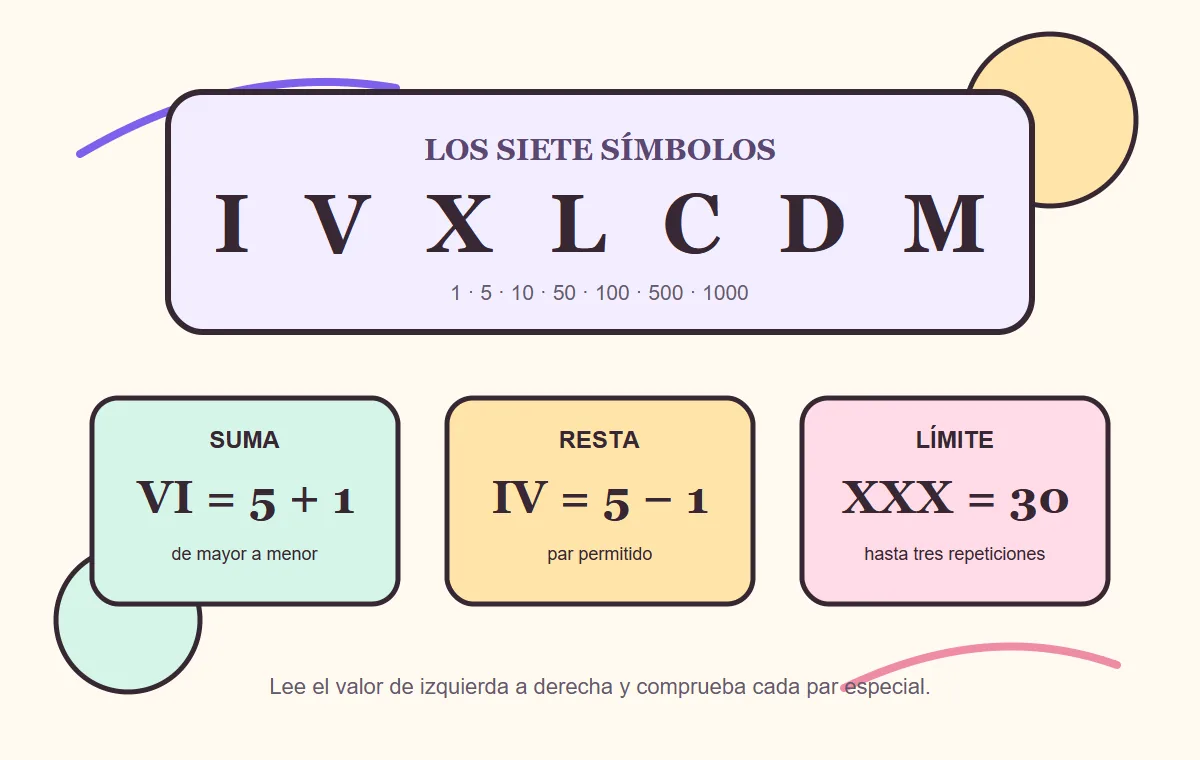
Roman numeral rules start with seven letters that have fixed values. They are normally written from large to small and added; a smaller letter is subtracted only in six valid pairs. I, X, C, and M may repeat up to three times, while V, L, and D do not repeat.
Use this Roman numeral rules guide as a checklist: Roman numeral rules are easiest to verify by blocks, and Roman numeral rules should always be compared with the original Arabic value.
When someone searches for Roman numeral rules, they usually need two things: a reason that a form is correct and a reliable way to convert a specific example. This guide separates each decision so you can check it in order. The goal is not an endless list of answers. It is recognizing patterns that work for small numbers, dates, chapter numbers, and classroom exercises.
The modern system uses uppercase Latin letters. A number such as XXVII is 10 + 10 + 5 + 1 + 1, so it equals 27. IV is different: I comes before V, so it means 5 minus 1 and equals 4. Position matters. Changing IV to VI changes both the operation and the answer. If a spelling feels unusual, split it into smaller groups and test each group.
The seven symbols and three quick checks for reading a Roman numeral.1 · SYMBOLS
The seven symbols and their values
The first Roman numeral rule is knowing the value of each letter. There is no new symbol for every number: letters combine in order. I means one, V five, X ten, L fifty, C one hundred, D five hundred, and M one thousand. Memorizing this scale lets you rebuild tens and hundreds without relying on a full lookup table.
The scale also helps you spot an odd sequence. A letter after a larger value is normally added; a letter before a larger value must be checked against the allowed subtractive pairs. VX, for example, is not the standard form for 15. XV is the standard spelling.
Symbol
Value
Typical use
I
1
Units; may come before V or X in subtraction.
V
5
Five point; never repeated.
X
10
Tens; may come before L or C in subtraction.
L
50
Fifty point; never repeated.
C
100
Hundreds; may come before D or M in subtraction.
D
500
Five hundred point; never repeated.
M
1000
Thousands; may repeat up to three times in standard form.
Key idea: read from left to right, but pause when a smaller letter comes before a larger one. That small group needs a subtraction check.
2 · ADDITION
The addition rule: large to small
Addition is the most common case. When symbols appear in descending order or have equal values, add each contribution. VII is 5 + 1 + 1, so it is 7. XXXII is 10 + 10 + 10 + 1 + 1, so it is 32. The spelling stays readable because each block keeps its place value.
For a compound number, split it into thousands, hundreds, tens, and units. For 248, use CCXLVIII: CC is 200, XL is 40, and VIII is 8. You do not need to add a long random chain. Separating blocks shows which rule applies and prevents a subtraction pair from being mixed with a group that should only be added.
VII = 7V + I + I: every value moves from larger to smaller.
XXVIII = 28XX contributes 20 and VIII contributes 8; read the blocks in order.
CCXLVIII = 248CC = 200, XL = 40, and VIII = 8; then add the three blocks.
3 · SUBTRACTION
The subtraction rule: only six pairs
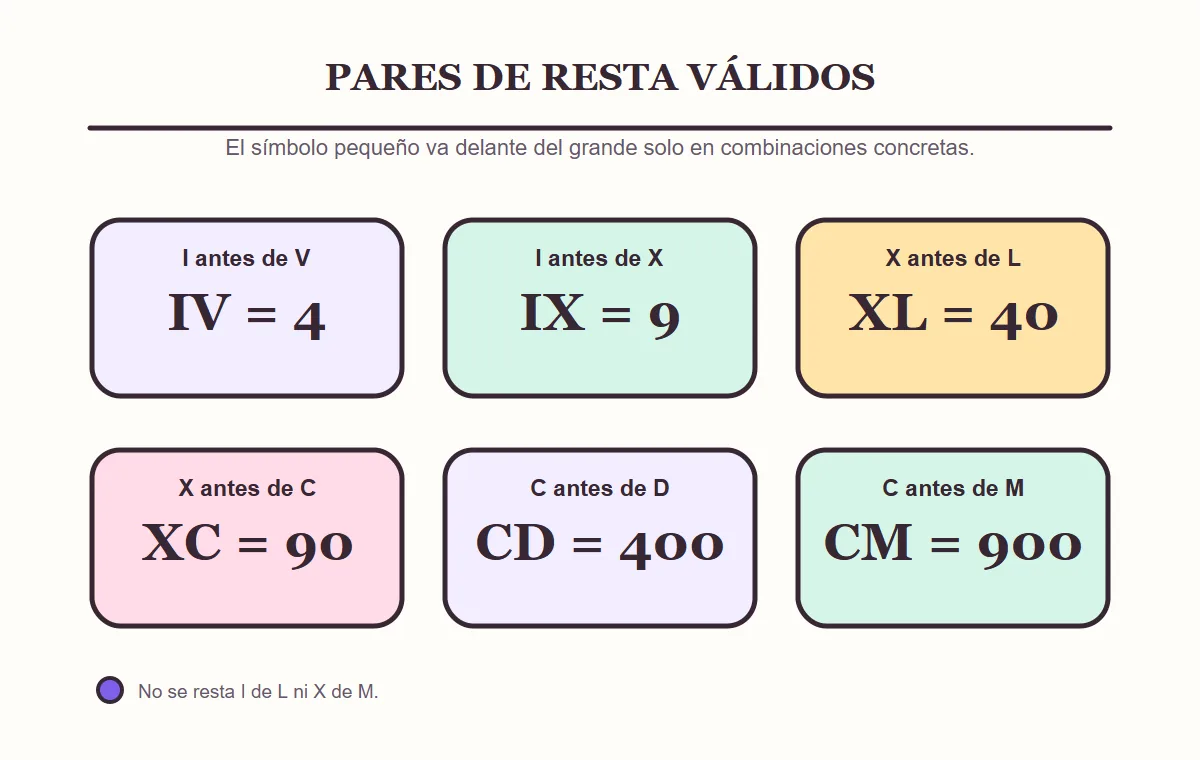
Subtraction keeps Roman numerals compact, but it does not allow any small letter to sit before any large letter. Roman numeral rules accept six pairs: I before V or X; X before L or C; and C before D or M. In each pair, subtract the first value from the second.
IV means 4 because I is allowed before V. IX means 9 because I is allowed before X. In the same way, XL is 40, XC is 90, CD is 400, and CM is 900. These are the common modern forms used on clocks, titles, dates, and documents.
Pair
Value
Why it is valid
IV
4
I is subtracted from V.
IX
9
I is subtracted from X.
XL
40
X is subtracted from L.
XC
90
X is subtracted from C.
CD
400
C is subtracted from D.
CM
900
C is subtracted from M.
IV, IX, XL, XC, CD, and CM are the standard subtractive pairs.
Do not generalize subtraction: IL, IC, XD, and XM are not standard forms. Forty-nine is XLIX and ninety-nine is XCIX.
4 · REPETITION
How many times can a letter repeat?
I, X, C, and M may repeat up to three times in a row in standard notation. III is 3, XXX is 30, and CCC is 300. A fourth copy is not written as IIII or XXXX in a modern school guide; switch to the matching subtractive block, such as IV or XL.
V, L, and D are not repeated. Do not write VV for 10, LL for 100, or DD for 1000. The standard forms are X, C, and M. This rule reduces ambiguity and keeps the pattern stable across units, tens, and hundreds.
Allowed up to three times: I, X, C, and M.
Never repeated: V, L, and D.
Do not mix four repeats with an invented subtraction; switch to the standard block.
Distinguish a decorative clock variant from academic standard spelling.
5 · LARGE VALUES
What happens after 3999?
The common school form covers 1 through 3999 and uses M for one thousand. Larger values need an additional convention. A vinculum, or overline, multiplies the covered group by one thousand: V̅ represents 5000 and X̅ represents 10,000. In plain text the line may be a combining mark, and fonts do not all render it in the same way.
Roman numeral rules for very large values are less uniform than the forms from 1 to 3999. Historical styles use bars, parentheses, or apostrophes. If the result will be engraved, printed, or set in a special font, confirm that the line is visible and agree on the convention with the reader or designer.
MMXXVI = 2026A typical year uses standard notation without an overline.
IV̅ = 4000The overline multiplies the IV group by one thousand.
V̅ = 5000Check the typeface before using a vinculum in a design.
6 · METHOD
A four-step method for converting
When you meet a new number, use this short method. It is more reliable than trying to remember a complete result and works both when converting Arabic digits and when checking a Roman spelling.
1Split by place value
Separate thousands, hundreds, tens, and units so each block has a clear scale.
2Choose standard blocks
Use M, D, C, L, X, V, and I, plus IV, IX, XL, XC, CD, and CM when needed.
3Read left to right
Add descending symbols and subtract only when one of the six valid pairs appears.
4Check the limits
Review repeats, symbols that cannot repeat, and an overline when the value exceeds 3999.
7 · CHECK
Common mistakes and how to fix them
Most mistakes do not come from difficult arithmetic. They come from applying a correct rule in the wrong place. Comparing the spelling with the unit, tens, and hundreds pattern usually exposes the problem in a few seconds.
Writing IIII, XXXX, or VV in a standard answer.
Using IL, IC, XD, or XM as if every value could be subtracted.
Forgetting that XIV is X + IV, not one subtraction.
Copying an incomplete year: 95 and 1995 are different values.
Assuming an overline will display well in every typeface.
Changing day-month-year order without explaining the convention to the reader.
FAQ
Questions about Roman numeral rules
What are the basic Roman numeral rules?
Use the seven symbols with fixed values, normally write from large to small, and add the blocks. Subtract only in IV, IX, XL, XC, CD, and CM. I, X, C, and M may repeat up to three times; V, L, and D do not repeat.
Why does IV equal 4 while VI equals 6?
In IV, I comes before V and forms an allowed subtraction: 5 − 1 = 4. In VI, I follows V and is added: 5 + 1 = 6. Position changes the operation.
Can I write IL for 49?
Not in standard form. Forty-nine is 40 + 9, so it is XLIX. IL is not one of the six valid subtractive pairs.
How many times can a letter repeat?
I, X, C, and M may appear up to three times in a row. V, L, and D are not repeated. Some clock faces use IIII for style, but academic examples usually teach IV.
How are values over 3999 written?
A vinculum, or overline, can multiply the covered group by one thousand. Because historical and typographic variants exist, confirm the style before printing or engraving.
How do I check a date in Roman numerals?
Separate the day, month, and year, convert each component, and keep the order your audience understands. Check February and the full year before copying; the site's date converter validates the calendar.
NEXT STEP
Practice with the site's tools
After reading Roman numeral rules, check real conversions and compare every block with its Arabic value. Use the tool that matches your task.